Interstitium and Ayurveda
The Interstitium Through the Lens of Ayurveda: Exploring a Modern Anatomical Discovery Through Classical Ayurvedic Principles
Introduction
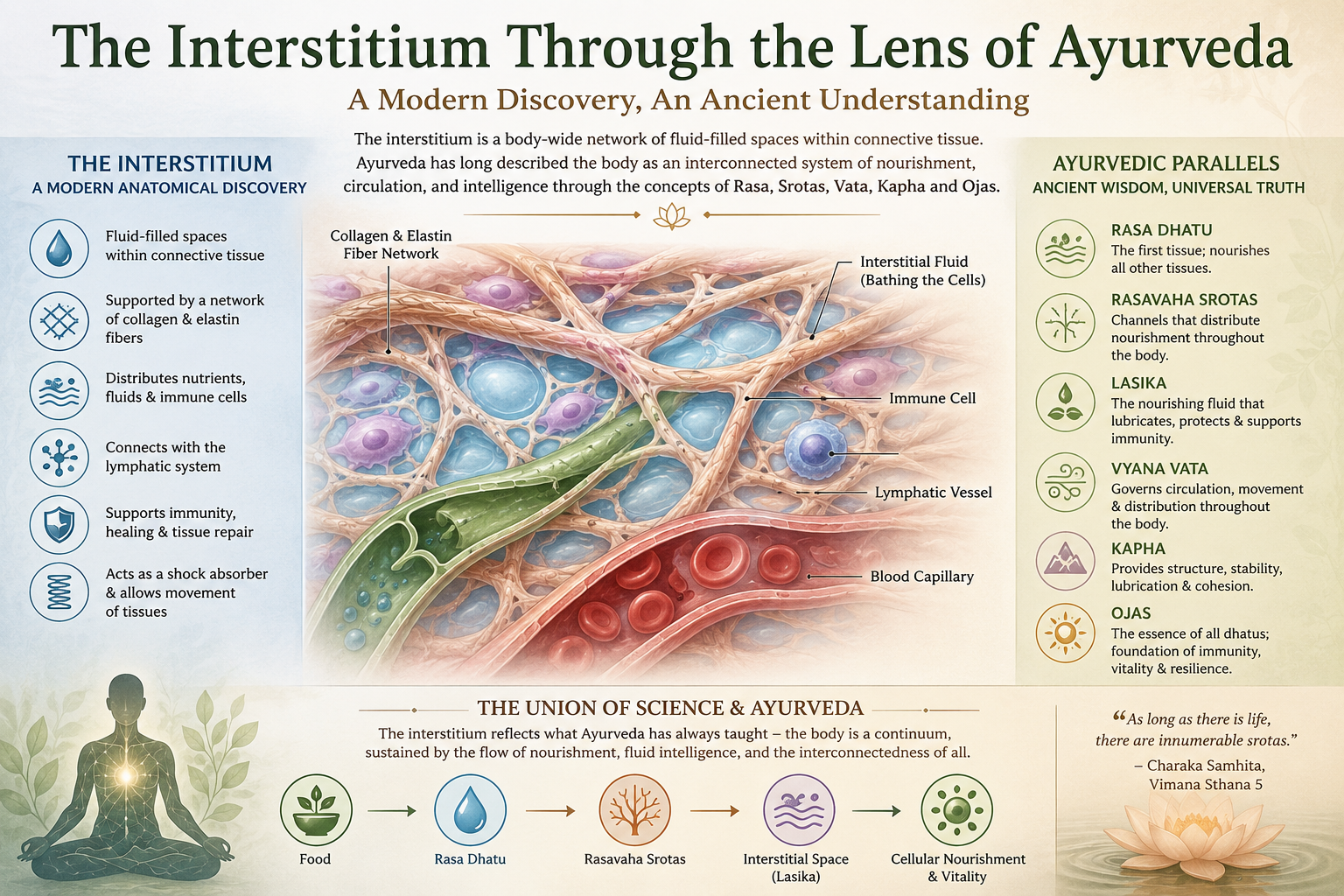
In 2018, researchers described a widespread network of fluid-filled spaces within connective tissues throughout the body known as the **interstitium**. Found beneath the skin, around muscles, blood vessels, nerves, and organs, these spaces form a dynamic fluid environment that supports communication, nourishment, immune activity, and tissue repair. While scientists continue to debate whether the interstitium should be classified as a distinct organ or as part of the connective tissue system, its discovery has expanded our understanding of how the body's tissues are interconnected.
Although the interstitium is a modern anatomical discovery and is not specifically described in the classical Ayurvedic texts, many of its functions parallel concepts that have been discussed in Ayurveda for thousands of years. The Ayurvedic understanding of Rasa Dhatu, Srotas, Lasika, Vyana Vata, Kapha, Ojas and Akasha Mahabhuta provides a framework through which this discovery can be explored.
It is important to note that the interstitium does not "prove" Ayurvedic concepts, nor do the Ayurvedic texts specifically identify this structure. Rather, the discovery offers an opportunity to examine how ancient descriptions of nourishment, fluid movement, communication, and interconnectedness may correspond with modern anatomical observations.
---
What Is the Interstitium?
For generations, anatomy has focused primarily on organs, blood vessels, lymphatics, nerves, and connective tissues. The interstitium reveals that much of the body's connective tissue contains fluid-filled spaces supported by collagen and elastin fibers. These spaces were often overlooked because traditional tissue preparation techniques caused them to collapse before microscopic examination.
Rather than being empty gaps between tissues, these spaces form a living, dynamic network through which fluids, nutrients, immune cells, and signaling molecules move.
Researchers currently believe the interstitium contributes to:
* Shock absorption and cushioning
* Fluid transport
* Nutrient exchange
* Waste removal
* Immune surveillance
* Wound healing and tissue repair
* Mechanical communication between tissues
* Lymphatic drainage
One useful analogy is a sponge. The collagen and elastin fibers form the structural framework, while fluid occupies the spaces within that framework. Every cell of the body exists within and depends upon this fluid environment.
The discovery emphasizes that health depends not only upon individual cells and organs but also upon the spaces and communication pathways between them.
---
Ayurveda's Emphasis on Interconnectedness
One of the defining characteristics of Ayurveda is its emphasis on relationships and communication within the body.
The classical texts repeatedly describe:
* Movement of nourishment
* Distribution of biological intelligence
* Networks of channels (Srotas)
* Fluid circulation
* Tissue nourishment
* Elimination of waste products
Ayurveda views the body as an integrated whole in which all tissues continuously communicate and support one another. Disease develops when these processes become obstructed, depleted, excessive, or disturbed.
The interstitium offers a modern anatomical perspective that resonates with this holistic understanding.
---
Rasa Dhatu: The Foundation of Nourishment
Among the Ayurvedic concepts, **Rasa Dhatu** may provide the closest functional comparison to the nourishing role of the interstitial environment.
Rasa is the first dhatu formed after digestion and is responsible for nourishing all tissues of the body.
Charaka states:
"Rasa nourishes all the tissues of the body."
--Charaka Samhita, Chikitsa Sthana 15--
Rasa performs several functions:
* Nourishment
* Hydration
* Transportation of nutrients
* Support of vitality
* Foundation for subsequent dhatus
Modern physiology recognizes that nutrients delivered by the bloodstream must first enter the interstitial fluid before reaching individual cells. Every cell is continuously bathed in this fluid environment.
From an Ayurvedic perspective, the interstitial fluid surrounding every cell resembles one aspect of the nourishing function of Rasa Dhatu.
---
Srotas: The Channels of Communication
Ayurveda describes a vast network of channels known as **Srotas**.
Charaka explains:
"Srotas are the channels through which nourishment and other substances circulate throughout the body."
--Charaka Samhita, Vimana Sthana 5--
He further notes:
"As long as there is life, there are innumerable srotas."
--Charaka Samhita, Vimana Sthana 5--
This statement is remarkable because it suggests that the body contains countless pathways for movement and communication beyond the obvious anatomical structures visible to the naked eye.
The interstitium may represent one component of these innumerable channels. Rather than functioning solely through discrete vessels, the body appears to possess a continuous communication network extending through connective tissues and fluid spaces.
---
Rasavaha Srotas and Nutrient Distribution
Within the broader system of Srotas, Ayurveda identifies Rasavaha Srotas, the channels responsible for carrying and distributing nourishment.
Charaka identifies the roots of Rasavaha Srotas as:
* Hridaya (heart)
* Dasha Dhamani (ten great vessels)
The primary function of Rasavaha Srotas is the distribution of nourishment throughout the body.
Modern physiology demonstrates that nutrients leave blood vessels, enter interstitial fluid, and are then delivered to tissues and cells. This process closely parallels the Ayurvedic description of nourishment moving through Rasavaha Srotas.
---
Lasika: The Closest Fluid Correlation
Perhaps the strongest Ayurvedic parallel to the interstitium is the concept of Lasika.
In Ayurvedic literature, Lasika is described as a clear fluid associated with:
* Lubrication
* Moisture
* Nourishment
* Protection
* Fluid balance
Traditional commentators have often correlated Lasika with:
* Lymphatic fluid
* Interstitial fluid
* Extracellular fluid systems
Modern physiology recognizes that interstitial fluid continuously drains into the lymphatic system.
The fluid pathway may be summarized as:
--Blood Plasma → Interstitial Fluid → Lymphatic Fluid → Venous Circulation--
This relationship closely resembles Ayurvedic descriptions of Lasika as a nourishing and protective fluid that circulates throughout the body.
---
Vyana Vata and Physiological Movement
The body-wide movement occurring within the interstitium strongly reflects the functions of **Vyana Vata**.
Charaka describes Vyana Vata as:
"That which moves throughout the entire body."
--Charaka Samhita, Chikitsa Sthana 28--
Vyana Vata governs:
* Circulation
* Distribution
* Movement
* Coordination
* Communication throughout the body
The continuous flow of fluids, nutrients, signaling molecules, and mechanical forces through the interstitium reflects these fundamental functions.
The interstitial network may therefore be viewed as one of the physical environments through which Vyana Vata expresses itself physiologically.
---
Kapha and Structural Integrity
While Vata governs movement, the structural framework of the interstitium reflects many qualities of Kapha Dosha.
According to the Ayurvedic texts, Kapha provides:
* Stability
* Cohesion
* Lubrication
* Structural support
* Protection
The collagen and elastin fibers that form the interstitial framework embody these qualities. They provide the stable matrix necessary for the movement of fluids and information throughout the body.
Without this Kapha-like structure, communication and nourishment would lack organization and support.
---
Ojas and the Interstitial Matrix
One of the most intriguing Ayurvedic interpretations involves Ojas, the refined essence of all seven dhatus.
Charaka states:
"Ojas is the essence of all dhatus."
--Charaka Samhita, Sutra Sthana 17--
Ojas is associated with:
* Immunity
* Vitality
* Resilience
* Healing capacity
* Longevity
Modern research demonstrates that immune cells, inflammatory mediators, growth factors, and healing signals move extensively through interstitial spaces.
While Ojas is not equivalent to interstitial fluid, the interstitial environment may serve as one of the physiological mediums through which the protective and nourishing effects of Ojas are expressed throughout the body.
---
Akasha Mahabhuta: The Forgotten Connection
Perhaps the most profound Ayurvedic correlation is found in Akasha Mahabhuta, the element of space.
According to Ayurveda, Akasha is characterized by:
* Space
* Accommodation
* Porosity
* Openness
* Potential for movement
The classical texts teach that all structures contain Akasha.
The interstitium is literally a network of spaces within tissues. These spaces allow fluid movement, communication, nutrient exchange, and physiological coordination.
In many ways, the discovery of the interstitium reminds us that health depends not only upon the solid structures of the body but also upon the spaces between them.
This concept has been central to Ayurvedic philosophy since its earliest formulations.
---
A Holistic Understanding
When viewed through an Ayurvedic lens, the interstitium can be understood as a modern anatomical phenomenon that reflects several classical principles simultaneously:
Ayurvedic Concept Potential Relationship to the Interstitium
Rasa Dhatu Nourishment and hydration of tissues
Rasavaha Srotas Distribution of nutrients throughout the body
Lasika Interstitial and lymphatic fluid movement
Vyana Vata Circulation, communication, and transport
Kapha Structural support and cohesion
Ojas Immune resilience and vitality
Akasha Mahabhuta The spaces that allow physiological function
None of these concepts are exact equivalents. Rather, each provides a different perspective on aspects of the interstitium's structure and function.
---
Conclusion
The discovery of the interstitium represents an important advancement in modern anatomy. It highlights the existence of a body-wide fluid communication network that supports nourishment, immune activity, tissue repair, and physiological coordination.
Although the interstitium is not specifically described in the Vedas, the Charaka Samhita, the Sushruta Samhita, or the Ashtanga Hridayam, its functions closely parallel several foundational Ayurvedic concepts, including Rasa Dhatu, Rasavaha Srotas, Lasika, Vyana Vata, Kapha, Ojas, and Akasha Mahabhuta.
The interstitium does not validate Ayurveda, nor does Ayurveda require validation from modern science. However, this discovery provides a fascinating bridge between ancient observations and contemporary research.
For Ayurvedic practitioners, it serves as a reminder of a timeless principle: health is not merely the condition of individual organs or tissues, but the harmonious flow of nourishment, communication, intelligence, and vitality throughout the entire organism. The interstitium offers a modern glimpse into the physical interconnectedness that Ayurveda has emphasized for thousands of years.